Euro and sterling: Why holding both currencies makes business sense

Article snapshot
In this article, we look at the operational challenges of managing euro and sterling payments, who is most affected, and what to consider when choosing a business account designed for trading across both currencies.
TL;DR
- Managing euro and sterling separately creates conversion costs and reconciliation hassle for Ireland-UK traders.
- A dual-currency account lets businesses hold both currencies and convert between them on their own schedule.
- Fire gives local IBANs/account details in each currency, plus SEPA, Faster Payments, and FX services in one platform.
- Clients like Circit and Straight Teeth Direct use it to cut FX costs and simplify reconciliation.
–
Many businesses regularly receive payments in euro while paying suppliers and beneficiaries in sterling, or vice versa. For companies trading between Ireland and the United Kingdom (UK), managing two currencies is often part of day-to-day operations.
Without the right account setup, this can lead to unnecessary conversion costs, additional administration, and less control over when funds are exchanged between currencies. These costs may seem small on individual transactions, but they can add up over time, particularly for businesses making regular cross-border payments.
A euro and sterling business account allows businesses to hold, receive and send payments in both currencies from one platform. Rather than converting funds every time a payment is received, businesses can choose when to exchange currencies, helping them manage cash flow and foreign exchange (FX) costs more effectively while maintaining balances across both currencies.
In this article, we look at the operational challenges of managing euro and sterling payments, who is most affected, and what to consider when choosing a business account designed for trading across both currencies.

The challenges of operating across two currencies
For businesses managing payments in both euro and sterling, the costs are not limited to currency conversion. Day-to-day operations can become more complex, particularly as payment volumes increase.
Common challenges include:
- Conversion costs when funds are exchanged between euro and sterling.
- Exchange rate exposure when currencies are converted as payments are received or sent.
- Managing multiple bank accounts, often across different providers.
- Additional payment steps required to move funds between accounts before making payments.
- More complex reconciliation when matching transactions and balances across two currencies.
Who benefits from a euro and sterling business account?
. For some, that means invoicing UK customers in sterling while paying employees and suppliers in euro. For others, it means collecting payments in euro from customers across the euro area while managing business costs in sterling. Holding both currencies allows businesses to work in the currency that makes sense for each transaction, rather than converting funds every time they make or receive a payment.
This is particularly relevant for businesses with customers, suppliers or partners on both sides of the Irish Sea. Software companies, online platforms, professional services firms, manufacturers, wholesalers and travel businesses often receive and make payments in both currencies as part of their day-to-day operations.
Fire supports many businesses with these payment requirements. For example, Circit, an audit collaboration platform serving accounting firms across Ireland and the UK, uses Fire’s euro and sterling accounts to receive customer payments in both currencies, manage foreign exchange when required, and simplify reconciliation by keeping funds in the original payment currency until they are needed.
Similarly, Straight Teeth Direct, a digital healthcare provider with customers in more than 50 countries, uses Fire to hold both euro and sterling. The business can retain funds in each currency and exchange them when appropriate, helping reduce unnecessary foreign exchange activity while supporting its international growth.
What a dual-currency account actually does
A dual-currency account allows businesses to receive, hold and send payments in both euro and sterling without converting funds every time a payment is made or received.
For example, an Irish business can receive GBP payments from UK customers, hold the funds in a sterling account, and use them to pay UK suppliers or settle invoices. If funds need to be converted into euro, the business can choose when to exchange currencies rather than converting automatically.
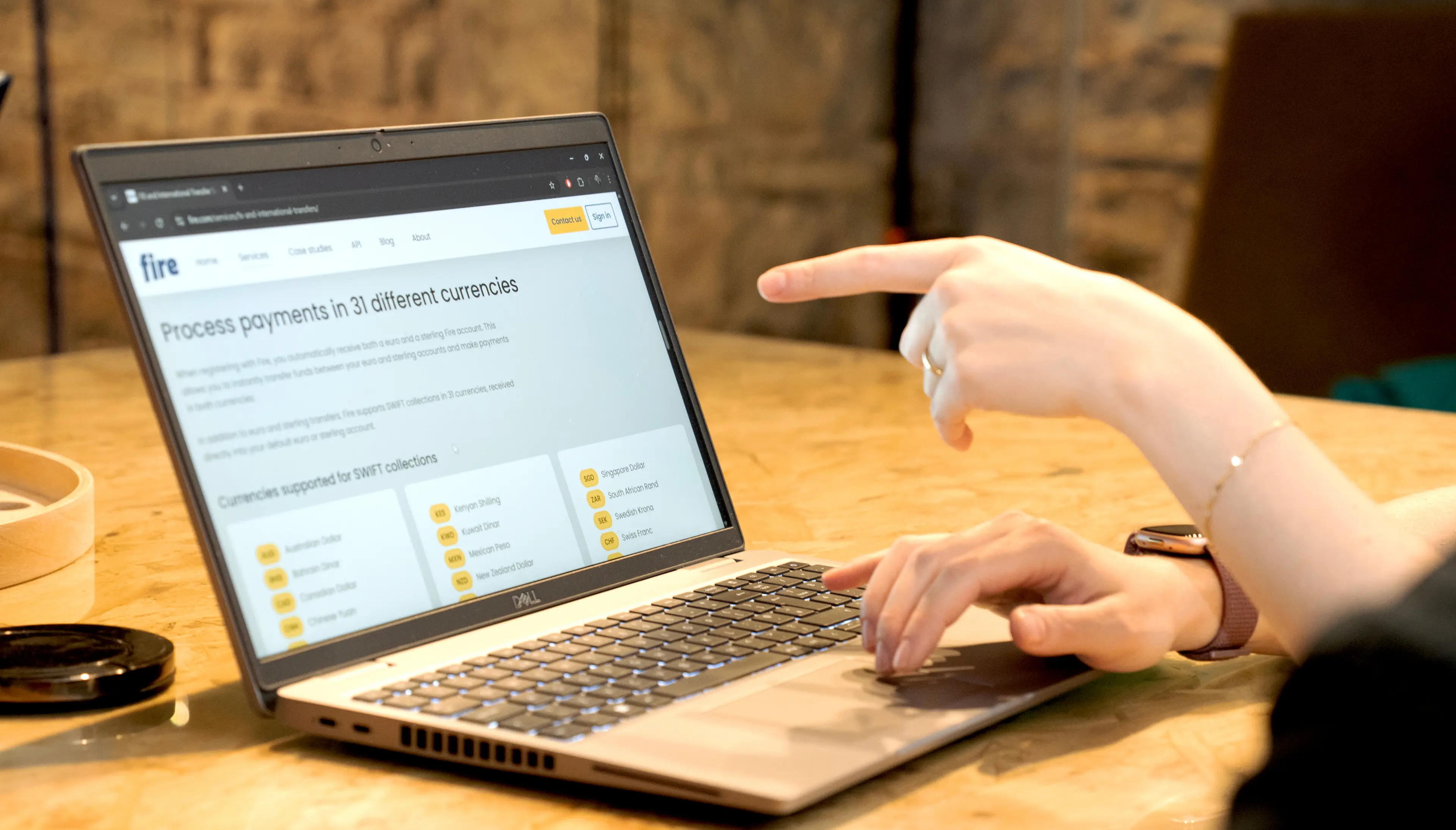
With Fire’s euro and sterling accounts, businesses can manage both currencies through one platform, with separate account details for euro and sterling payments. This includes Irish and European IBANs (International Bank Account Numbers) for euro accounts and UK account details for sterling, giving businesses access to local payment schemes such as SEPA for euro payments and Faster Payments for sterling transactions. This allows businesses to send and receive payments like a local in each market, rather than relying on international payment routes.
Through Fire’s FX services, businesses can exchange between euro and sterling when needed, helping them improve visibility over balances and simplify cross-border payment management.

The cost difference: conversion fees vs holding
For businesses trading in both euro and sterling, frequent currency conversion can create additional costs. Each conversion may involve exchange rate movements and FX margins, while using international payment routes instead of local payment rails can add further costs and complexity.
For companies that regularly trade with the UK, keeping balances in both currencies can provide more flexibility. Instead of converting payments immediately, businesses can hold funds in the currency in which they are received and use them for future expenses in that same currency, such as paying suppliers or managing operational costs.
Fire allows businesses to hold and manage multiple currencies in one place, giving them greater control over when euro and sterling funds are exchanged. Through Fire’s FX services, businesses can convert currencies when needed while maintaining visibility over both balances.
What to look for in a dual-currency business account
Not all dual-currency accounts offer the same level of flexibility. When comparing providers, consider whether the account offers:
- Local account details for each currency, such as IE IBANs and UK account details, making it easier to send and receive local payments.
- Transparent FX services with clear exchange rates and the flexibility to convert funds when needed. Fire’s FX services are designed to help businesses manage euro and sterling payments through one platform.
- Visibility over both currency balances, allowing finance teams to monitor cash flow and manage payments without switching between multiple banking providers.
- API access and payment automation, particularly for platforms or businesses processing higher payment volumes. Fire’s Payments API enables businesses to integrate payments, automate workflows and simplify reconciliation.
Choosing an account with these features can help simplify day-to-day payment operations and support businesses that trade regularly between Ireland and the UK.
Manage your euro and sterling business account with Fire
Businesses trading between Ireland and the UK often need to receive payments in one currency while making payments in another. Fire’s euro and sterling accounts allow businesses to hold, receive and send payments in both currencies, with access to local payment schemes and FX services through a single platform.
Learn more about Fire’s Payments and Accounts or contact our team to discuss your cross-border payment requirements.
–
FAQs
Can an Irish business hold sterling in a business account?
Yes. Fire lets Irish businesses hold GBP balances alongside EUR, receive payments in sterling, and make GBP payments without needing a separate UK banking relationship.
Do I need separate accounts for euros and pounds?
Fire allows businesses to manage both currencies through a single platform.
What are the benefits of holding sterling rather than converting to euros immediately?
Holding sterling can help businesses reduce unnecessary conversions and retain flexibility over when funds are exchanged.
Is a dual-currency account useful for businesses?
Yes, particularly if you regularly invoice or pay in a second currency. Even a small reduction in FX fees and rate losses adds up over a year’s worth of transactions.
How does Fire support businesses operating across Ireland and the UK?
Fire provides IE IBANs for euro accounts and UK account details for sterling accounts, allowing businesses to hold, receive and send payments in both currencies through a single platform. Businesses can also access FX services and local payment schemes, including SEPA for euro payments and Faster Payments for sterling transactions.