A business guide to getting started with SEPA Instant

Article snapshot
A guide for finance teams and ops managers on what SEPA Instant is, what it costs, what it replaces, and what you actually need to get started.
Overview
- SEPA Instant sends and receives euro payments in under ten seconds, 24 hours a day, 365 days a year.
- Under EU rules, it cannot cost more than a standard SEPA credit transfer, so faster settlement does not mean a higher fee.
- It removes the wait for next-day clearing and the need to plan payment runs around banking hours, using only a euro account with a provider that supports the scheme.
- This guide explains how SEPA Instant works, what it costs, what it replaces and what you need in place to get started.
Why SEPA Instant matters for your business
For many businesses, euro payments have traditionally been shaped by next-day settlement. Whether paying suppliers or receiving funds, payment processes have often been dictated by cut-off times, working days, and delays over weekends.
SEPA Instant changes this by allowing euro payments to settle in seconds rather than waiting until the next working day. For finance teams and operations managers, this can improve visibility over incoming funds, support faster supplier payments and increase operational efficiency.
This guide is designed for finance and operations teams that want to understand what SEPA Instant could mean for their business. We’ll look at the practical benefits, what needs to be considered before getting started, and how instant payments can fit into your existing processes. For more information on implementation and APIs, see our guides on integrating SEPA Instant Payments into your business and how APIs are making SEPA Instant Payments easier to adopt.
What is SEPA Instant and how does it work?
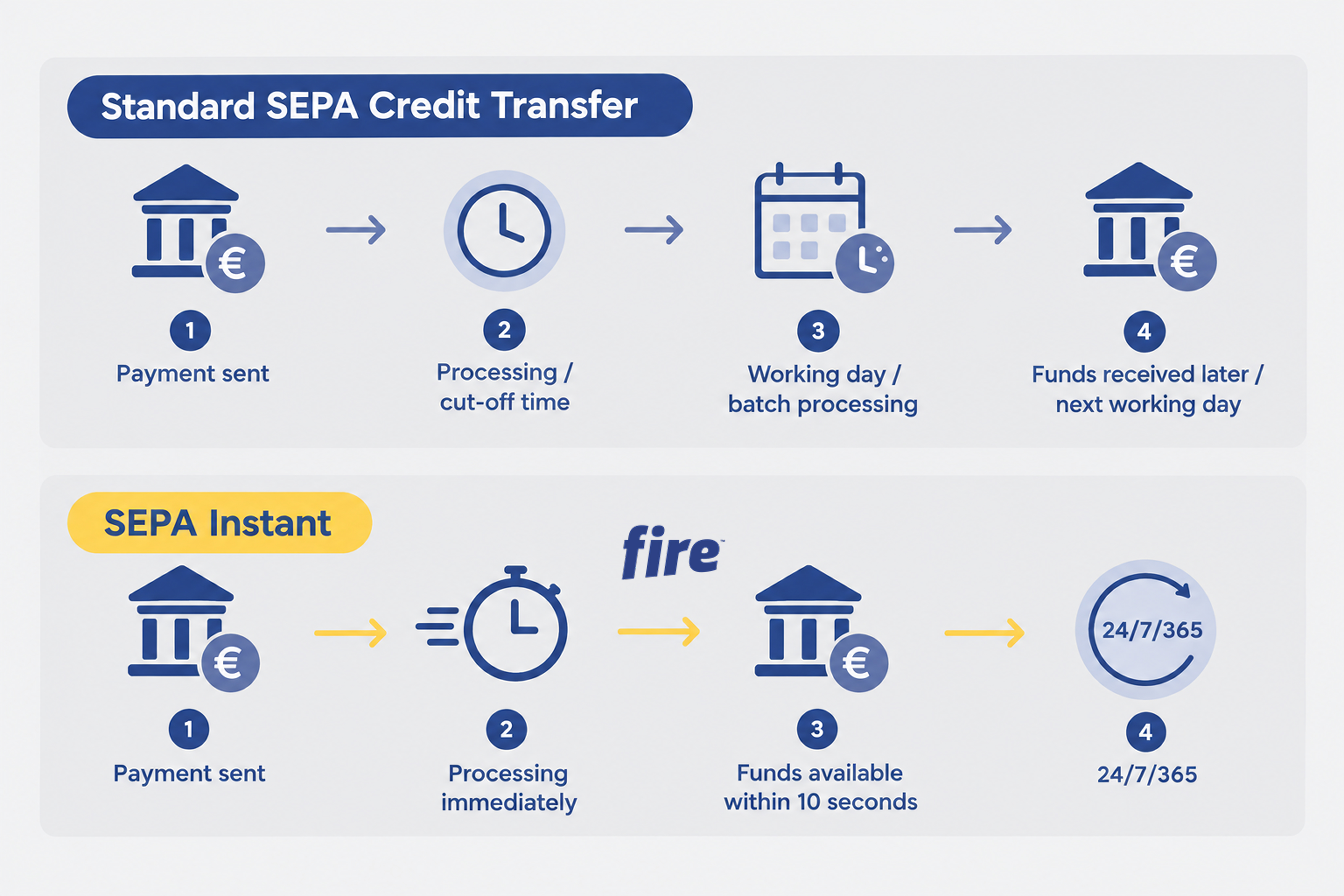
SEPA Instant Credit Transfer (SCT Inst) is a payment scheme that allows eligible euro payments to be sent and received in seconds. The scheme is managed by the European Payments Council (EPC) and is designed to make funds available to the recipient within 10 seconds, 24 hours a day, 365 days a year, including weekends and public holidays.
The main difference between SEPA Instant and a standard SEPA Credit Transfer is the speed at which payments are processed. Standard SEPA Credit Transfers can be subject to processing cycles, cut-off times and working-day schedules. SEPA Instant payments are processed continuously, allowing funds to reach the recipient within seconds rather than waiting until the next working day.
SCT Inst currently spans 37 European countries, with 2,820 payment service providers participating in the scheme. The EU’s Instant Payments Regulation is also expanding the number of providers required to offer instant euro payments.
There is no maximum transaction amount set at scheme level for SEPA Instant. However, individual banks and payment service providers can set their own transaction or daily limits. This means the amount you can send or receive may depend on the provider and the payment method you use.
For businesses, the practical difference is simple; SEPA Instant allows eligible euro payments to move within seconds, around the clock, helping businesses reduce their reliance on banking hours, cut-off times and next-day settlement.
What does SEPA Instant actually cost?
Cost is an important consideration for businesses looking to use SEPA Instant. Under the EU Instant Payments Regulation, providers cannot charge more for an instant euro credit transfer than they charge for the corresponding standard credit transfer. This means the faster settlement of an instant payment should not come with a higher transaction fee than the equivalent standard transfer.
When comparing providers, it is worth looking beyond the individual transaction fee and considering the wider pricing structure. This may include account fees, API access, batch or bulk payment charges and other service costs. Checking the full pricing model can help you understand the overall cost of using instant payments as your payment volumes grow.
At Fire, SEPA Instant is available alongside our existing euro payment services. You can view our current Business Account pricing, or contact our team for more information on pricing and payment options.
What does SEPA Instant replace?
SEPA Instant can reduce reliance on several processes businesses may currently use to manage payments and cash flow.
- Standard SEPA Credit Transfers: Instead of waiting for a payment to arrive on the next working day, SEPA Instant makes funds available within seconds, 24 hours, 7 days a week, 365 days a year.
- Manual payment runs: Businesses can make payments 24/7, reducing the need to schedule payment runs around banking hours, cut-off times, weekends or bank holidays.
- Slower payment methods: Instant payments provide a faster electronic alternative when other payment methods would take longer to reach the recipient.
- Waiting for funds to clear: When payment needs to be received before goods or services can be released, instant payments can make funds available much sooner, reducing delays between payment and fulfilment.
- Batch processing and reconciliation delays: Faster availability of funds can help businesses reconcile invoices sooner and reduce delays associated with traditional payment processes.
What changes when you move to SEPA Instant?
Transitioning to SEPA Instant changes how quickly businesses can send, receive, and confirm payments. For finance and operations teams, this can mean better visibility over cash flow, faster confirmation of payments, and less reliance on traditional payment cycles.
Payment approval processes may need to adapt too. With instant payments available 24/7, businesses should consider whether their approval and authorisation processes can support payments outside traditional banking hours. This may include reviewing who can approve payments, how approval thresholds are applied, and what happens when a payment needs attention outside normal working hours.
Reconciliation can also happen sooner. Faster payment confirmation allows finance teams to update records and track incoming and outgoing payments without waiting for the following morning’s bank feed or a traditional processing cycle. For operations teams, quicker confirmation can also help trigger the next step in a workflow sooner, such as releasing an order, confirming a booking, or progressing a customer or supplier request.
Supplier, contractor and partner expectations may change as well. Faster settlement can reduce delays in receiving funds, particularly where payment needs to be confirmed before goods or services are released. This can make payment status more useful as an operational trigger, rather than simply an accounting update.
The change is therefore not only about faster payments. Businesses may need to review the processes that sit around those payments, including approval, reconciliation, fulfilment, exception handling, and customer or supplier communications. Finance and operations teams should consider whether their payment, treasury, accounting, and operational systems can support faster payment flows and confirmations. The ECB notes that businesses need to integrate their ERP and treasury systems with their payment service provider’s instant payment capabilities to take full advantage of instant payments.
What do you need in place to use SEPA Instant?
If you are ready to get started, there are a few practical requirements to check first.
A provider that supports SEPA Instant
Your bank or payment service provider needs to support SEPA Instant for the payments you want to make and receive. Check the European Payments Council’s register of participants to confirm whether your provider participates in the scheme.
Eligible euro accounts and accurate IBANs
Verification of Payee
Verification of Payee can help businesses check that the payee name and IBAN correspond before a payment is authorised. For finance and operations teams, this can provide an additional control against misdirected payments and help reduce errors in payment workflows.
Payment approvals that can operate 24/7
With instant payments available around the clock, so businesses should consider whether their approval and authorisation processes can support payments outside standard banking hours.
A process for rejected or failed payments
Instant payments can be rejected, so businesses should have a clear process for identifying the reason and deciding whether a payment needs to be corrected and resubmitted.

Common questions from finance and operations teams
SEPA Instant operates within the regulated European payments framework, with Verification of Payee (VoP) helping to identify potential mismatches between the payee name and IBAN before a payment is authorised. This can help finance and operations teams reduce payment errors and strengthen controls around outgoing payments.
If a payment is sent to the wrong account, a recall may be possible, including in cases of fraud or technical error. However, an instant payment cannot simply be cancelled once it has settled, so businesses should have appropriate checks in place before sending payments.
There is no maximum transaction amount set at scheme level, although individual payment providers can set their own limits. A business may need to use a provider that supports sending and receiving SEPA Instant payments. This is particularly relevant when instant payments are being built into operational workflows, such as supplier payments, customer collections, or payment-triggered fulfilment processes.
Suppliers and partners do not need to change their payment details to receive an instant payment. They need an eligible euro payment account with a provider that can receive SEPA Instant payments. This means businesses can generally use their existing payment details when moving from standard to instant euro transfers, subject to the receiving provider and account being reachable for SCT Inst.
How Fire makes SEPA Instant accessible for businesses
Fire makes SEPA Instant available through its business payment accounts, without requiring a complex setup or a complete change to your existing banking processes. Payments can be made through the Fire user portal or automated through the Fire API for Payments.
Payment controls can be built into the process. Multi-user authorisation allows businesses to require additional approval before payments are processed, while configurable permissions help align payment access with internal responsibilities. Once payments are submitted, real-time notifications and webhooks can provide updates as payment events occur. This can help finance teams keep records up to date while allowing operations teams to trigger the next step in a workflow without relying on manual checks or waiting for a later banking update.
Fire supports both one-off payments and automated euro transfers through its API, giving businesses flexibility in how they manage payments. Businesses can therefore start with payments through the Fire platform and introduce automation as their requirements grow. For teams integrating SEPA Instant into existing systems, Fire also provides API documentation and a testing environment to support the integration process. Talk to Fire about getting your business set up for SEPA Instant payments.
–
FAQs
What is SEPA Instant and how is it different from a regular bank transfer?
SEPA Instant enables eligible euro payments to reach recipients within 10 seconds, 24/7, unlike standard SEPA transfers which follow traditional processing cycles.
How fast does a SEPA Instant payment actually settle?
Within 10 seconds, 24 hours a day, 365 days a year.
Which countries and banks support SEPA Instant?
SCT Inst currently spans 36 European countries, with more than 2,800 participating payment service providers.
Is there a maximum amount you can send via SEPA Instant?
There is no scheme-level maximum, but individual providers can set their own limits.
Is SEPA Instant safe for business payments?
Yes. It operates within the regulated European payments framework, with Verification of Payee helping reduce fraud and payment errors.
What happens if a SEPA Instant payment goes to the wrong account?
It cannot simply be cancelled after settlement, but a recall may be possible depending on the circumstances.
Do both the sender and recipient need to support SEPA Instant?
Yes. The recipient’s provider must be able to receive SCT Inst payments.
This article references Fire’s products or services. It is not advice or a recommendation. Customers should consider their own circumstances and, where appropriate, seek independent professional guidance before making any decisions.