Open banking helps marketplaces cut card fees while keeping trust

Article snapshot
How marketplace operators can reduce card processing costs without compromising trust by adopting open banking solutions that support scalable, compliant and secure payment flows for buyers and sellers.
Open banking marketplace payouts
Online marketplaces continue to grow as customers seek greater choice and flexibility. These platforms connect customers with multiple sellers, spanning food delivery, ride-sharing, second-hand goods and freelance services.
While marketplaces have always connected buyers and sellers, digital platforms now facilitate these interactions at scale, linking customers with multiple third-party providers through a single online environment.
Payment processing in digital marketplaces is more complex than in standard e-commerce transactions, as funds must move between customers, the platform and multiple sellers. The platform typically sits at the centre of this process, collecting payments and distributing funds, often with traditional card fees increasing costs and extending payout times.
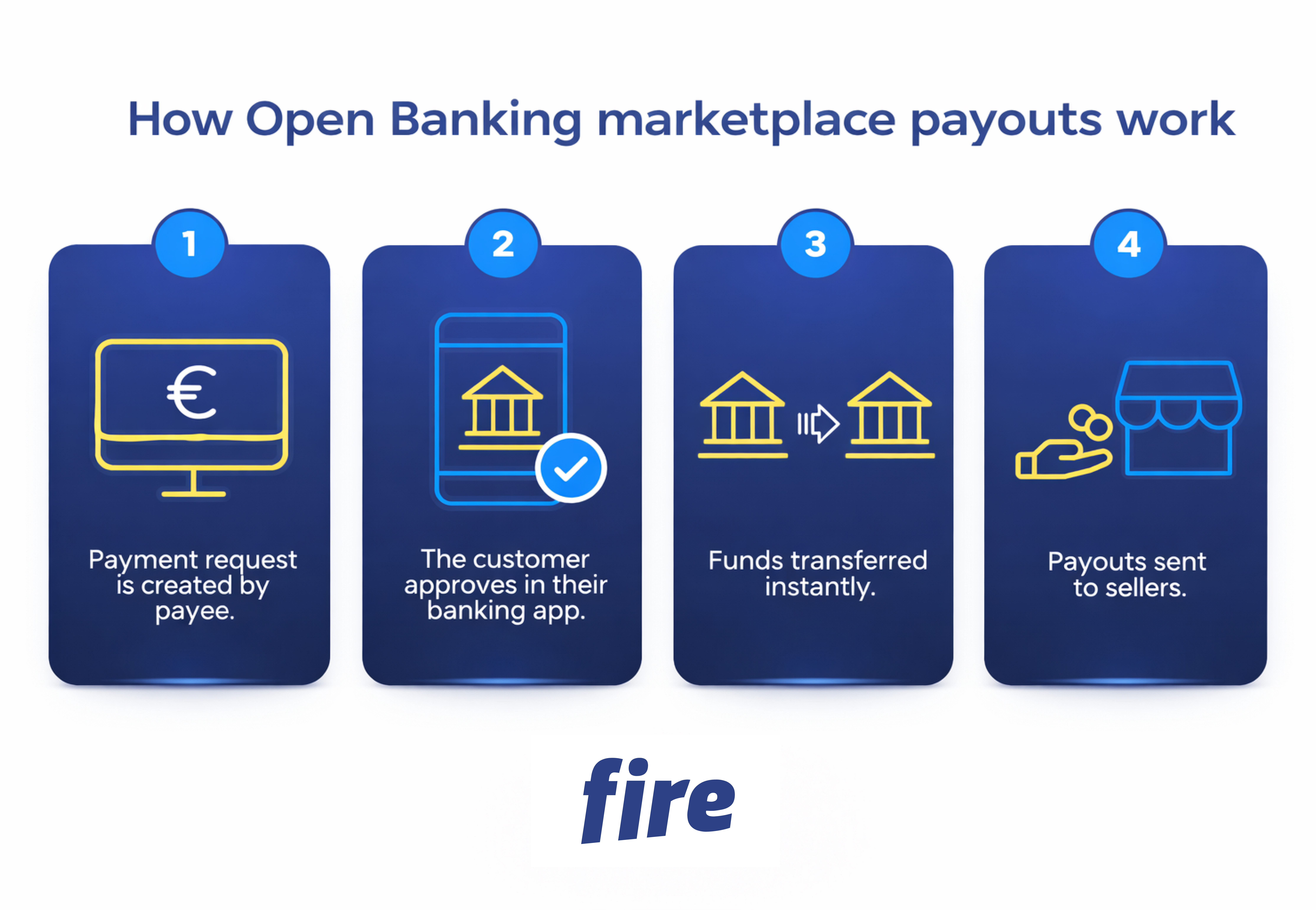
Open banking marketplace payouts offer an alternative for platforms looking to reduce the card fees that marketplaces typically incur, without affecting user trust. By enabling direct account-to-account payments, funds can be collected, held, split and distributed within a structured account framework, supporting faster settlement and improved cost control.
In this article, we explore how open banking marketplace payouts work within the marketplace model and how they can help create a more efficient, lower-cost payment structure while maintaining a smooth customer experience.
Why card fees are a challenge for marketplaces
Cost
Payment acceptance can significantly reduce margins for both marketplaces and the sellers using their platforms. Standard card fees vary by provider and industry, typically ranging from 0.2% to 2.9% per transaction. In addition, platforms may face recurring service fees, maintenance charges, and costs associated to chargebacks or declined authorisations.
Chargebacks add further overhead, particularly in marketplaces where multiple parties are involved in each transaction. These factors make card-based payments both costly and inefficient for many platforms.
Settlement delays
Card payments are typically processed in bulk once per day. After settlement, the platform must distribute funds to sellers, deducting any applicable fees. For small business sellers, slower payouts can create cash flow pressure.
In marketplaces, settlement delays are typically longer than in standard e-commerce transactions because funds pass through the platform before reaching the sellers. Open banking marketplace payouts can accelerate settlement, improve liquidity for sellers, and support a seamless customer experience.
What is open banking payment acceptance?
Open banking payments are account-based payments where a platform or merchant initiates a payment that the customer approves directly from their bank account.
The payee, typically a merchant or platform, uses a Payment Initiation Service Provider (PISP) to start the payment. The payer then selects their bank, known as the Account Servicing Payment Service Provider (ASPSP), to authorise the transfer.
What open banking brings to marketplaces
Cost
Processing costs are typically lower than card payments. Per-transaction fees are reduced, and chargeback and refund costs may also decrease, as payments are authorised directly through the customer’s bank. This helps marketplaces lower the card fees they would otherwise incur while maintaining a secure payment experience.
Settlement
Account-to-account payments can settle more frequently, and in some cases, instantly. Marketplaces receive funds sooner, gain real-time visibility into payment status, and can distribute payouts to sellers more quickly. Faster settlement supports stronger cash flow management and operational efficiency.
Reconciliation
Open banking payments provide detailed transaction data, including references and order identifiers, simplifying reconciliation and reporting. Some providers also enable additional information to be captured during the payment journey.
Consumer choice
Adding open banking expands payment options for buyers while giving sellers greater flexibility in how they receive funds.
Integrated services
Where a provider offers both payment initiation and account services, marketplaces can manage collections, fee splitting, and bulk disbursements through a single API. Automated payouts, fund segregation, and currency conversion can further streamline operations.
Designing an open banking-powered buyer journey
Open banking payments are straightforward to implement and can be offered alongside other payment methods, or as the primary option. Platforms typically display a “Pay by bank” choice during checkout.
A typical open banking payment journey for the user:
- The user selects “Pay by bank” and consents to the payment.
- The user is redirected to their bank or account provider’s app to authorise the payment.
- The user returns to the platform, where the payment outcome is displayed.
Some providers offer a hosted checkout, allowing the user to complete the payment on the provider’s interface. Larger marketplaces often integrate the payment pages into their own User Interface (UI) and User Experience (UX). Giving them control over elements such as bank logos, returning customer preferences, and confirmation of payment and order fulfilment, all within the provider’s regulatory standards.
From a customer perspective, the experience is similar to paying by card, with a few key differences:
- Instead of entering card details, the payer chooses their account provider.
- Authentication occurs in the customer’s banking app rather than through a third party, offering a familiar yet secure process akin to 3D Secure for cards.
- For marketplaces, integrating open banking payments can reduce friction at checkout, provide a familiar user experience, and support faster, lower-cost settlement.

How Fire’s API for Payments fits into the marketplace stack
The Fire Payments API allows marketplaces to accept payments via open banking and manage payouts to sellers, all through a single API integration and a unified Fire account structure.
Payments are initiated directly from the buyer’s current account, with funds settled into a Fire account that includes segregated sub-accounts for each seller. The platform can automatically split payments, separating its own fees from the remainder to be paid to sellers.
Funds can then be disbursed to sellers’ bank accounts via the batch payment API, either on a daily schedule, at any chosen frequency, or triggered by sellers themselves. Transaction data can also be pulled through the API for internal reporting or shared with sellers as needed without moving between multiple providers or systems.
Fire’s API reference, guides and recipes are available, alongside experienced integration support from our team to assist at each stage, from design and implementation through to testing.
Cutting card costs without cutting corners on trust
Many marketplace platforms are now looking for practical ways to reduce card fees while maintaining a trusted payment experience. Integrating open banking payments enables marketplace platforms to lower payment acceptance costs without compromising security or user experience. Buyers authorise payments directly with their bank, while sellers benefit from improved liquidity through account-to-account payments.
With Fire’s open banking payments and the Fire Payments API, marketplaces can automate payment initiation, fund segregation, and seller disbursements through a single, secure integration, supporting a gradual shift away from higher-cost card networks.
To explore how Fire can help your marketplace reduce costs and improve payout efficiency, contact our team today.
–
FAQ section
What are open banking payments and how do they apply to marketplaces?
Open banking payments are an account-based payment method, allowing businesses to get paid by initiating a bank transfer from their payer’s account via open banking, with the payer’s consent. In a marketplace setting, open banking payments help to reduce costs and settlement delays, while maintaining rich transaction data flows for the payee to support reconciliation.
Can open banking really reduce payment processing fees for marketplaces?
Yes, the costs per transaction and associated overheads are lower than that of card schemes. This is especially true for repeat customers and high-value transactions.
Will buyers trust a “Pay by bank” option as much as cards?
“Pay by bank” may be a new option for customers, but the familiar bank branding and authentication through the payer’s trusted banking app promotes trust in this payment method. Good UX design and communication are key to adoption, ensuring a simple but effective way for the customer to understand their payment is being executed by their trusted bank provider, and processed by secure third parties.
How do open banking payments and payouts via marketplaces work for sellers?
With the right provider, funds collected by marketplaces via open banking can be settled, fee split can be automated, and funds can then be disbursed to sellers all under the same provider – meaning faster and more transparent settlement times for sellers.
How difficult is it to integrate open banking into an existing marketplace?
Integrating open banking payments into an existing marketplace platform is typically fast and straightforward, and can be integrated alongside existing payment methods without affecting existing infrastructure.
–